Calisthenics for Beginners Build Strength Flexibility and Endurance Without Equipment

Fitness can get complicated fast. Programs, machines, apps, supplements, and expensive gear all compete for attention. Calisthenics brings training back to something simple and powerful: learning how to move your own body well.
With bodyweight training, the gym is optional. A living room floor, a park, a doorway pull-up bar, or a sturdy playground bar can be enough to build real strength. Push-ups train the chest, shoulders, arms, and core. Squats build the legs and hips. Pull-ups develop the back and grip. Planks teach control. Lunges improve balance. Put together with patience, these movements can support strength, flexibility, endurance, and confidence.
Calisthenics also meets you where you are. A beginner can start with wall push-ups and chair squats. A seasoned athlete can work toward archer push-ups, pistol squats, handstands, and strict pull-ups. The method scales by changing angles, range of motion, tempo, and leverage.
This article is informational only. If you have pain, an injury, or a medical condition, get guidance from a qualified health professional before beginning a new routine.

Why calisthenics is such a strong place to start
Calisthenics teaches the body to work as one connected system. That is one reason it feels different from many machine-based exercises. A push-up does not only train the chest. It also asks the core, glutes, shoulders, wrists, and upper back to help stabilize the movement.
That full-body demand is useful for daily life. Getting off the floor, climbing stairs, carrying groceries, hiking, playing sports, and moving with ease all rely on coordinated strength. Calisthenics builds that kind of strength through patterns the body already understands.
It also removes many common barriers to training.
You do not need a crowded gym. You do not need to wait for equipment. You do not need a perfect setup. A short session at home can still count.
The biggest benefits include:
Better relative strength
Relative strength means how strong you are compared with your body weight. Pull-ups, push-ups, squats, and core holds all train this directly.
Improved mobility and flexibility
Deep squats, lunges, bridges, mountain climbers, and active warm-ups help teach joints to move through safe, useful ranges.
Greater muscular endurance
Repeating controlled bodyweight movements builds the ability to keep producing force without fading quickly.
Better body awareness
Calisthenics makes form obvious. If the hips sag in a push-up or the knees collapse in a squat, the body gives clear feedback.
Easy progression
Every exercise has beginner, intermediate, and advanced versions. Small adjustments can make a movement easier or harder.
That mix makes calisthenics for beginners practical, challenging, and motivating. Progress often feels personal because every new rep, deeper squat, or cleaner hold reflects direct control of your own body.
The foundation exercises that build the most strength
A good beginner routine does not need dozens of exercises. It needs a few strong patterns practiced well. Think of calisthenics in six main categories: push, pull, squat, hinge, core, and locomotion.
Push-ups build upper-body strength and control
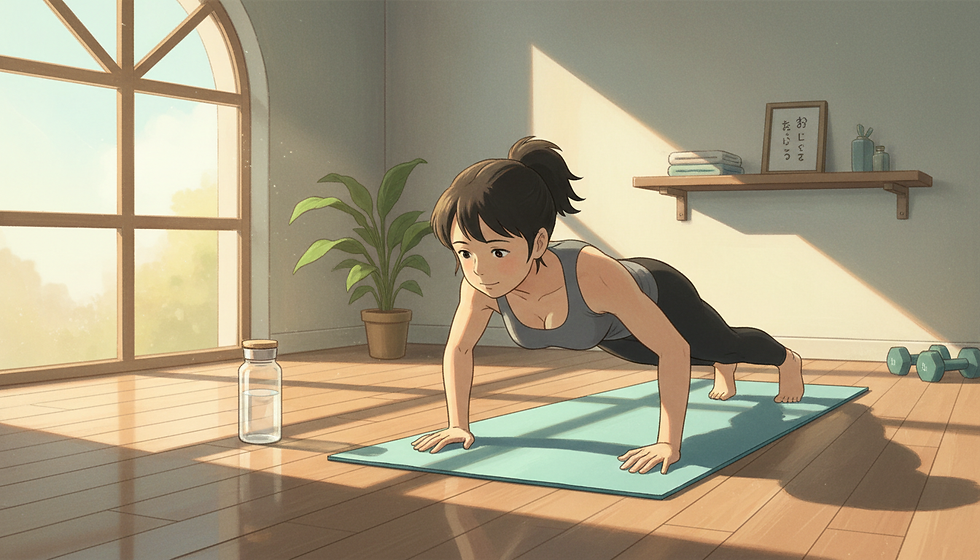
Push-ups train the chest, shoulders, triceps, and core. They also teach a strong plank position, which carries over into many other exercises.
A clean push-up starts with the hands under or slightly wider than the shoulders. The body forms a straight line from head to heels. The elbows bend as the chest lowers toward the floor. The hips should not sag, and the head should not reach forward.
Beginners can start with:
Wall push-ups
Countertop push-ups
Incline push-ups on a bench or sturdy table
Knee push-ups
Full push-ups
A useful cue is to lower with control, pause briefly, then press the floor away. Quality matters more than speed. Five clean reps beat 20 rushed reps with poor alignment.
Pull-ups develop the back and grip
Pull-ups are one of the best bodyweight exercises for the upper back, biceps, forearms, and core. They are also one of the hardest for beginners, so patience helps.
A pull-up requires a safe overhead bar. That could be a doorway pull-up bar, a park bar, or a sturdy playground bar. If no bar is available, table rows can train a similar pulling pattern, as long as the table is stable and safe.
Good pull-up progressions include:
Dead hangs
Scapular pulls
Negative pull-ups
Assisted pull-ups with a resistance band or foot support
Full pull-ups
For dead hangs, grip the bar and let the body hang with control. Keep the shoulders active rather than completely loose. Scapular pulls add a small movement where the shoulder blades pull down and back without bending the elbows.
Negative pull-ups are especially helpful. Start at the top position with the chin over the bar, then lower slowly. This builds strength through the hardest part of the movement.

Squats build strong legs and mobile hips
Bodyweight squats train the quads, glutes, hamstrings, calves, and core. They also improve ankle, knee, and hip mobility when practiced through a comfortable range.
Start with feet about shoulder-width apart. Toes can point slightly outward. Sit the hips down and back while keeping the chest lifted. The knees should track in the same direction as the toes. Press through the whole foot to stand tall.
Beginner versions include:
Sit-to-stand squats from a chair
Box squats to a bench or step
Assisted squats while holding a door frame
Full bodyweight squats
Tempo squats with a slow lowering phase
A great goal is to make each rep smooth and balanced. Do not chase depth if the lower back rounds or the heels lift. Range of motion can grow over time.
Lunges and split squats improve balance
Single-leg exercises expose left-to-right differences and build balance. Reverse lunges are often more beginner-friendly than forward lunges because they place less sudden stress on the front knee.
Start tall. Step one foot back. Lower under control. Push through the front foot to return to standing. Keep the torso upright and the front knee tracking over the toes.
If balance feels shaky, hold a wall or chair. Support is not cheating. It allows better practice.
Planks teach the core to resist movement
The core does more than create visible abs. It protects posture, links the upper and lower body, and helps control force.
A plank should feel like a full-body brace. Elbows under shoulders. Legs straight. Glutes lightly squeezed. Ribs pulled down. Neck neutral.
Start with short holds, even 10 to 20 seconds. Stop before form falls apart. Side planks, dead bugs, bird dogs, and hollow body holds are also excellent beginner core exercises.
How to start a beginner calisthenics routine
The best routine is the one you can repeat. Beginners often do too much too soon, then feel sore, frustrated, or bored. Start smaller. Build the habit. Let the workouts grow as your body adapts.
Three sessions per week is a strong starting point. Leave a rest day between sessions when possible. A simple full-body routine can take 25 to 40 minutes.
Use this simple beginner workout
Warm up for 5 to 8 minutes with easy movement:
Marching in place
Arm circles
Hip circles
Bodyweight good mornings
Gentle squats
Shoulder blade squeezes
Then complete the workout below.
Exercise | Beginner target | Easier option | Harder option |
Incline push-up | 2 to 3 sets of 6 to 10 reps | Wall push-up | Lower incline or floor push-up |
Bodyweight squat | 2 to 3 sets of 8 to 12 reps | Chair squat | Slow tempo squat |
Assisted row or pull-up progression | 2 to 3 sets of 5 to 8 reps | Dead hang | Negative pull-up |
Reverse lunge | 2 sets of 6 to 8 reps per side | Supported split squat | Deeper reverse lunge |
Plank | 2 to 3 holds of 10 to 30 seconds | Elevated plank | Longer hold or side plank |
Rest 60 to 90 seconds between sets. Rest longer if form starts to break down. Training should feel challenging, but not chaotic.
Finish with light stretching for the hips, calves, chest, shoulders, and back.

Form comes before more reps
Progress in calisthenics comes from control. Rushing through sloppy reps teaches the body to move poorly. Clean reps teach strength.
Use these form checks during every session:
Keep the ribs stacked over the hips during planks and push-ups.
Move through a range you can control.
Breathe during each rep rather than holding your breath the whole time.
Keep joints aligned, especially shoulders, knees, and wrists.
Stop a set when form changes sharply.
Video can help. Record a set from the side or front. Look for sagging hips, uneven shoulders, knees caving in, or shallow range of motion. The goal is not perfection. The goal is honest feedback.
Soreness is normal when starting, but sharp pain is not. If a movement hurts in a bad way, stop and choose an easier version. There is almost always a way to adjust the exercise.
Progression keeps training exciting
The body adapts when the challenge slowly increases. In calisthenics, adding weight is not the only path. You can progress by changing leverage, tempo, range of motion, sets, reps, rest time, and exercise difficulty.
For example, push-ups can progress like this:
Wall push-up
Countertop push-up
Bench push-up
Knee push-up
Full push-up
Feet-elevated push-up
Diamond or archer push-up
Squats can progress like this:
Chair squat
Assisted squat
Full squat
Pause squat
Split squat
Reverse lunge
Shrimp squat or pistol squat progression
Pulling strength can progress like this:
Dead hang
Scapular pull
Table row
Assisted pull-up
Negative pull-up
Full pull-up
Chest-to-bar pull-up
A good rule is to progress only when you can complete every set with steady form. If the next version feels too hard, stay where you are. Strength is built by repeated practice, not by skipping steps.
The best calisthenics progress often looks quiet: cleaner reps, more control, better balance, and less struggle with the same movement.
Flexibility and endurance grow with consistent practice
Calisthenics is not only about strength skills. It can also improve flexibility and endurance when workouts include full ranges of motion and steady pacing.
Deep squats help the ankles, knees, and hips learn to share movement. Lunges open the hip flexors. Push-ups and rows strengthen the shoulders through useful positions. Crawling patterns, mountain climbers, and bear holds build coordination while raising the heart rate.
For endurance, use circuits once basic form feels solid. A beginner circuit might look like this:
8 squats
6 incline push-ups
10 mountain climbers per side
20-second plank
30 to 60 seconds of rest
Repeat for 3 to 5 rounds at a pace that keeps technique clean. This kind of training builds muscular endurance and conditioning without needing machines.
To support flexibility, add short mobility work after training or on rest days. Focus on areas that feel restricted.
Useful choices include:
Hip flexor stretch
Calf stretch
Child’s pose
Deep squat hold with support
Chest doorway stretch
Thoracic rotations
Do not force stretches. Ease into them and breathe slowly. Over time, better mobility can make exercises feel smoother and more natural.

How to stay motivated long enough to see results
Motivation rises and falls. A simple plan carries you when motivation dips.
Start by tracking small wins. Write down the exercise version, sets, reps, and how it felt. A note like “incline push-ups, 3 sets of 8, felt stronger” gives clear proof of progress.
Set skill-based goals, not only appearance goals. Skills create momentum because they are measurable and rewarding.
Good beginner goals include:
Hold a plank for 45 seconds with clean form.
Complete 10 controlled bodyweight squats.
Perform 5 slow negative pull-ups.
Do 3 full push-ups without sagging.
Hang from a bar for 30 seconds.
Keep workouts visible in your week. Pick exact days. Pair training with something familiar, like after morning coffee or before dinner. Lay out clothes ahead of time if that removes friction.
Most of all, avoid comparing your starting point with someone else’s highlight. Calisthenics rewards patience. Every advanced movement was once a basic movement practiced many times.
A strong body can start with one clean rep
Calisthenics proves that fitness does not have to be complicated to be effective. Push-ups, pull-ups, squats, lunges, planks, and mobility work can build a body that is stronger, more flexible, and more enduring.
Begin with simple versions. Move with control. Progress one step at a time. Let form guide the pace.
The next workout does not need to be perfect. It just needs to happen. Clear a little space, choose a few movements, and start with one clean rep. Then build from there.

Comments